> ## Documentation Index
> Fetch the complete documentation index at: https://evalprotocol.io/llms.txt
> Use this file to discover all available pages before exploring further.
# Running Rollouts with a Remote Server
If you already have an agent, you can integrate it with Eval Protocol by
using the [RemoteRolloutProcessor](https://github.com/eval-protocol/python-sdk/blob/main/eval_protocol/pytest/remote_rollout_processor.py).
`RemoteRolloutProcessor` delegates rollout execution to a remote HTTP service
that you control. It's useful for implementing rollouts with your existing agent
codebase by wrapping it in an HTTP service.
## High Level Flow
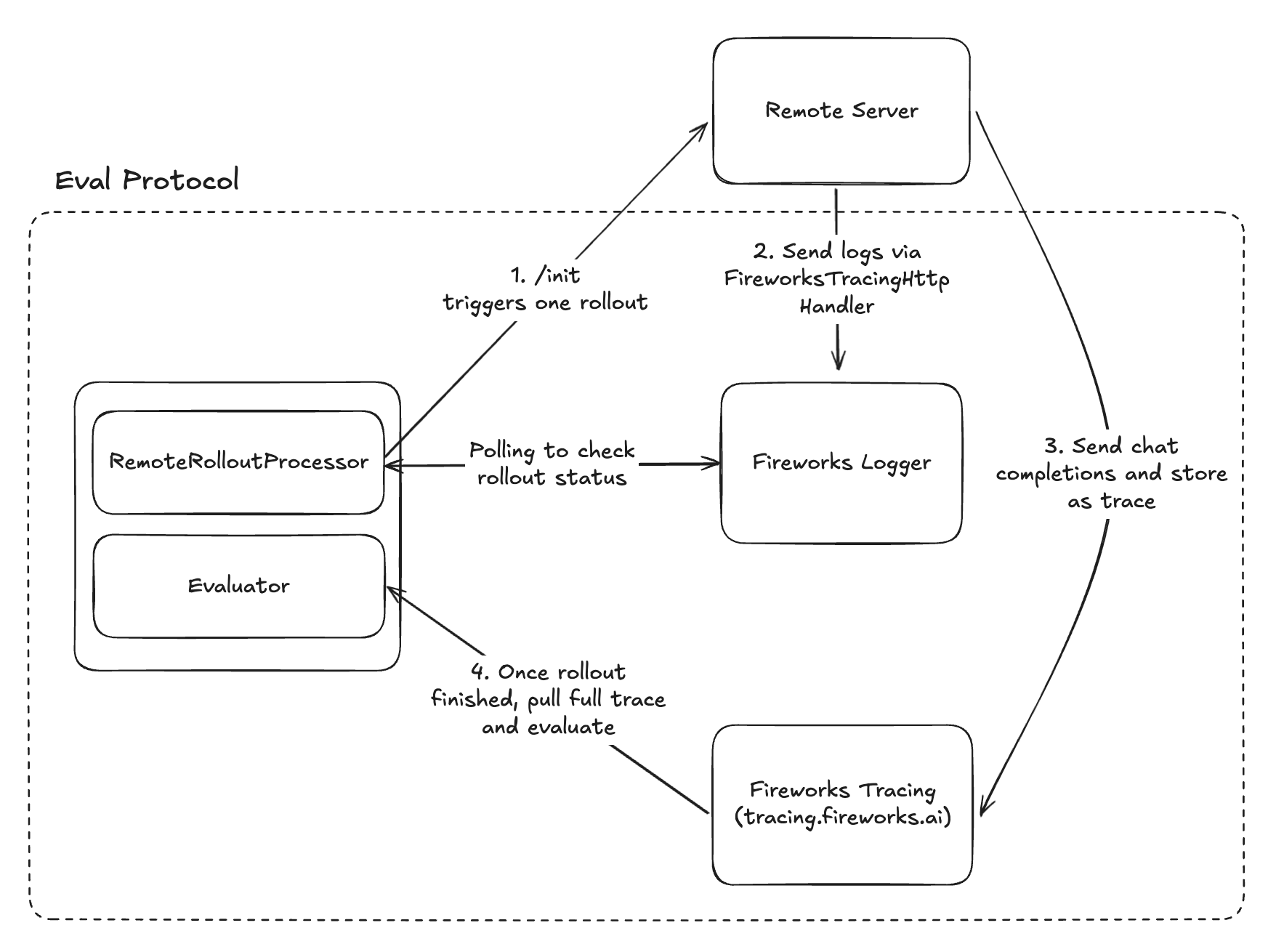 1. **/init triggers one rollout**: Eval Protocol calls your service’s POST `/init` with the row payload and correlation metadata.
2. **Send logs via `FireworksTracingHttpHandler`**: Your service emits structured logs tagged with the rollout’s correlation fields.
3. **Send chat completions and store as trace**: Your agent’s calls are recorded as traces in Fireworks.
4. **Once rollout finished, pull full trace and evaluate**: Eval Protocol polls Fireworks for a completion signal, then loads the trace and scores it.
Everything inside the dotted box is handled by Eval Protocol — you only need to implement the Remote Server, more on this below.
## API Contract
**POST /init:**
We expect the remote service to implement a single /init endpoint that accepts an `InitRequest` with the following fields:
Dictionary containing model and optional parameters like temperature, max\_tokens, etc.
Array of conversation messages
Array of available tools for the model
Base URL for the remote server to make LLM calls
Rollout execution metadata for correlation
API key to be used by the remote server
```json init_request.json theme={null}
{
"completion_params": {
"model": "accounts/fireworks/models/gpt-oss-120b",
"temperature": 0.7,
"max_tokens": 2048
},
"messages": [
{ "role": "user", "content": "What is the weather in San Francisco?" }
],
"tools": [
{
"type": "function",
"function": {
"name": "get_weather",
"description": "Get the weather for a city",
"parameters": {
"type": "object",
"properties": {
"city": { "type": "string" }
}
}
}
}
],
"model_base_url": "https://tracing.fireworks.ai/rollout_id/brave-night-42/invocation_id/wise-ocean-15/experiment_id/calm-forest-28/run_id/quick-river-07/row_id/bright-star-91",
"metadata": {
"invocation_id": "wise-ocean-15",
"experiment_id": "calm-forest-28",
"rollout_id": "brave-night-42",
"run_id": "quick-river-07",
"row_id": "bright-star-91"
},
"api_key": "fw_your_api_key"
}
```
## Metadata Correlation
When making model calls in your remote server, include the following metadata
in your traces and logs so that `eval-protocol` can correlate them with the
corresponding `EvaluationRow`s during result collection. `RemoteRolloutProcessor`
automatically generates this and sends it to the server, so you don't need to worry
about wrangling metadata.
* `invocation_id`
* `experiment_id`
* `rollout_id`
* `run_id`
* `row_id`
## Handling `InitRequest` in your Server
This section shows how to **parse the `InitRequest` fields and call your model**. Note: the `model_base_url` is a `tracing.fireworks.ai` URL that proxies your model calls so Fireworks can capture full traces for each rollout.
Below is a minimal FastAPI server showing how to wire this together.
```python remote_server.py theme={null}
@app.post("/init")
def init(req: InitRequest):
if not req.messages:
raise ValueError("messages is required")
model = req.completion_params.get("model")
if not model:
raise ValueError("model is required in completion_params")
# Spread all completion_params (model, temperature, max_tokens, etc.)
completion_kwargs = {"messages": req.messages, **req.completion_params}
if req.tools:
completion_kwargs["tools"] = req.tools
# Build OpenAI client from InitRequest
# You can also use req.api_key instead of an environment variable if preferred.
client = OpenAI(
base_url=req.model_base_url,
api_key=os.environ.get("FIREWORKS_API_KEY"),
)
completion = client.chat.completions.create(**completion_kwargs)
```
## Signaling Rollout Completion
The `RemoteRolloutProcessor` detects rollout completion by polling **structured logs** sent to Fireworks Tracing. Your remote server should use the appropriate SDK for your language to emit structured completion statuses.
The `eval-protocol` JS/TS SDK provides equivalent helpers:
* **`withFireworksLogging`**: Wraps your handler to automatically send structured logs to Fireworks Tracing.
* **`createRolloutLogger`**: Creates a rollout-scoped logger tagged with the current `rollout_id`.
* **`Status` / `mapOpenAIErrorToStatus`**: Helpers for emitting structured completion and error statuses.
```ts api/init.ts highlight={14-15, 20-21, 23-24, 29} theme={null}
import type { VercelRequest, VercelResponse } from '@vercel/node';
import {
initRequestSchema,
type InitRequest,
Status,
createRolloutLogger,
withFireworksLogging,
} from 'eval-protocol';
async function handler(req: VercelRequest, res: VercelResponse) {
const initRequest: InitRequest = initRequestSchema.parse(req.body);
// Extract rollout id from InitRequest payload and create rollout-specific logger
const rolloutId = initRequest.metadata.rollout_id;
const logger = createRolloutLogger(rolloutId);
try {
// Execute your rollout here
const status = Status.rolloutFinished();
logger.info(`Rollout ${rolloutId} completed`, { status });
} catch (error: any) {
const status = Status.rolloutInternalError(error.message);
logger.error(`Rollout ${rolloutId} failed: ${error.message}`, { status });
}
}
// Export wrapped handler so all logs go to Fireworks Tracing
export default withFireworksLogging(handler);
```
Add `FireworksTracingHttpHandler` as the logging handler, a `RolloutIdFilter`, and log completion status using structured `Status` objects:
```python remote_server.py highlight={5-6, 11-12, 18-21, 25-28} theme={null}
import logging
from eval_protocol import Status, InitRequest, FireworksTracingHttpHandler, RolloutIdFilter
# Configure Fireworks tracing handler
fireworks_handler = FireworksTracingHttpHandler()
logging.getLogger().addHandler(fireworks_handler)
@app.post("/init")
def init(request: InitRequest):
# Create rollout-specific logger with filter
rollout_logger = logging.getLogger(f"eval_server.{request.metadata.rollout_id}")
rollout_logger.addFilter(RolloutIdFilter(request.metadata.rollout_id))
try:
# Execute your rollout here
# Then log successful completion with structured status
rollout_logger.info(
f"Rollout {request.metadata.rollout_id} completed",
extra={"status": Status.rollout_finished()}
)
except Exception as e:
# Log errors with structured status
rollout_logger.error(
f"Rollout {request.metadata.rollout_id} failed: {e}",
extra={"status": Status.rollout_error(str(e))}
)
```
### Alternative: Environment Variable Approach
For the following setups, you can use the `EP_ROLLOUT_ID` environment variable instead of manual filters:
1. One rollout is processed per server instance
```python remote_server.py highlight={6} theme={null}
import os
import logging
from eval_protocol import Status, InitRequest, FireworksTracingHttpHandler
# Configure Fireworks tracing handler
os.environ["EP_ROLLOUT_ID"] = request.metadata.rollout_id
fireworks_handler = FireworksTracingHttpHandler()
logging.getLogger().addHandler(fireworks_handler)
logger = logging.getLogger(__name__)
@app.post("/init")
def init(request: InitRequest):
...
```
2. `/init` spawns separate Python processes
```python remote_server.py highlight={8-9} theme={null}
import os
import logging
import multiprocessing
from eval_protocol import FireworksTracingHttpHandler, InitRequest
def execute_rollout_step_sync(request):
# Set in the CHILD process
os.environ["EP_ROLLOUT_ID"] = rollout_id
logging.getLogger().addHandler(FireworksTracingHttpHandler())
# Execute your rollout here
@app.post("/init")
async def init(request: InitRequest):
# Do NOT set EP_ROLLOUT_ID here; set it in the child
p = multiprocessing.Process(
target=execute_rollout_step_sync,
args=(request),
)
p.start()
```
### How `RemoteRolloutProcessor` uses Fireworks Tracing
1. **Remote server logs completion**: Uses `Status.rollout_finished()` or `Status.rollout_error()`
2. **RemoteRolloutProcessor polls**: Searches logs by `rollout_id` tag until completion found
3. **Status extraction**: Reads structured status fields (`code`, `message`, `details`)
## Multi-Agent Setup Fine-tuning / Artifact Storage
One other use-case the `RemoteRolloutProcessor` enables is fine-tuning on multi-agent setups by storing artifacts. For example, let's say you have a Deep Research multi-agent setup and you want to fine-tune the first subagent, but the evaluation is on the artifact produced at the end of this entire multi-agent pipeline, e.g. the final deep research output. To accomplish this, we must store the artifact and correlate it with the subagent's output.
Pass custom data in the `extras` field when logging completion status:
Only log `Status.rolloutFinished()` **after the entire pipeline completes** and the final artifact is ready—not immediately when the subagent finishes. The completion log signals that evaluation can begin, so it must include all artifacts needed for scoring.
```ts api/init.ts theme={null}
// Wait for full pipeline to complete, then log with extras
const status = Status.rolloutFinished();
logger.info(`Rollout ${rolloutId} completed`, {
status,
extras: {
messages: result.messages,
research_report: result.report,
sources: result.citations,
}
});
```
```python remote_server.py theme={null}
# Wait for full pipeline to complete, then log with extras
rollout_logger.info(
f"Rollout {request.metadata.rollout_id} completed",
extra={
"status": Status.rollout_finished(),
"extras": {
"messages": result.messages,
"research_report": result.report,
"sources": result.citations,
}
}
)
```
The `RemoteRolloutProcessor` automatically extracts `extras` from the completion log and stores them in `row.execution_metadata.extra`. Access them in your evaluation function:
```python test_deep_research.py theme={null}
@evaluation_test(
input_dataset=[str(Path(__file__).parent / "research_dataset.jsonl")],
completion_params=[{"model": "accounts/fireworks/models/gpt-oss-120b"}],
rollout_processor=RemoteRolloutProcessor(
remote_base_url="https://your-server.vercel.app",
),
)
async def deep_research_evaluation(row: EvaluationRow) -> EvaluationRow:
# Access artifacts stored by your remote server
research_report = row.execution_metadata.extra["research_report"]
sources = row.execution_metadata.extra["sources"]
# Evaluate the final artifact
row.evaluation_result = evaluate_report_quality(research_report, sources)
return row
```
## Handling Rollout Failures
Rollouts can fail for various reasons: your remote server might crash, tracing might fail, or the model might not produce an assistant response. The `RemoteRolloutProcessor` automatically detects these failures and sets `row.rollout_status` accordingly.
The most common failure is when the rollout produces no assistant response. The SDK detects this and sets `row.rollout_status` to `Internal (13)` with the message "Rollout finished with the same number of messages as the original row".
Even when a rollout fails, your evaluation function is still called—giving you control over how to handle errors.
**Best practice:** Check `row.rollout_status.is_error()` at the start of your evaluation function to catch failed rollouts. This method returns `True` when the status code is `INTERNAL`:
```python test_my_eval.py theme={null}
from eval_protocol import EvaluateResult, EvaluationRow, evaluation_test
from eval_protocol.pytest import RemoteRolloutProcessor
@evaluation_test(
input_dataset=["dataset.jsonl"],
rollout_processor=RemoteRolloutProcessor(
remote_base_url="https://your-server.vercel.app",
),
completion_params=[{"model": "accounts/fireworks/models/gpt-oss-120b"}],
)
def test_my_evaluation(row: EvaluationRow) -> EvaluationRow:
# Check if rollout failed with internal error (e.g., no assistant response)
if row.rollout_status.is_error():
row.evaluation_result = EvaluateResult(
score=0.0,
reason=f"Rollout failed: {row.rollout_status.message}",
is_score_valid=False,
)
return row
# Proceed with normal evaluation logic
...
```
This catches the most common failure mode—when your remote server fails to produce an assistant response or encounters an internal error.
**Alternative:** Check the messages directly instead of relying on the SDK's error detection:
```python test_my_eval.py theme={null}
def test_my_evaluation(row: EvaluationRow) -> EvaluationRow:
# Check if no assistant response was produced
if not row.messages or row.messages[-1].role != "assistant":
row.evaluation_result = EvaluateResult(
score=0.0,
reason="No assistant response - rollout may have failed",
is_score_valid=False,
)
return row
# Proceed with normal evaluation logic
...
```
This approach doesn't depend on the SDK's status detection and directly validates that an assistant response exists.
## Example
See the following repos for end to end examples:
* [Remote Rollout Processor Hello World](https://github.com/eval-protocol/remote-rollout-processor-hello-world)
* [Typescript Vercel Example Server](https://github.com/eval-protocol/quickstart)
1. **/init triggers one rollout**: Eval Protocol calls your service’s POST `/init` with the row payload and correlation metadata.
2. **Send logs via `FireworksTracingHttpHandler`**: Your service emits structured logs tagged with the rollout’s correlation fields.
3. **Send chat completions and store as trace**: Your agent’s calls are recorded as traces in Fireworks.
4. **Once rollout finished, pull full trace and evaluate**: Eval Protocol polls Fireworks for a completion signal, then loads the trace and scores it.
Everything inside the dotted box is handled by Eval Protocol — you only need to implement the Remote Server, more on this below.
## API Contract
**POST /init:**
We expect the remote service to implement a single /init endpoint that accepts an `InitRequest` with the following fields:
Dictionary containing model and optional parameters like temperature, max\_tokens, etc.
Array of conversation messages
Array of available tools for the model
Base URL for the remote server to make LLM calls
Rollout execution metadata for correlation
API key to be used by the remote server
```json init_request.json theme={null}
{
"completion_params": {
"model": "accounts/fireworks/models/gpt-oss-120b",
"temperature": 0.7,
"max_tokens": 2048
},
"messages": [
{ "role": "user", "content": "What is the weather in San Francisco?" }
],
"tools": [
{
"type": "function",
"function": {
"name": "get_weather",
"description": "Get the weather for a city",
"parameters": {
"type": "object",
"properties": {
"city": { "type": "string" }
}
}
}
}
],
"model_base_url": "https://tracing.fireworks.ai/rollout_id/brave-night-42/invocation_id/wise-ocean-15/experiment_id/calm-forest-28/run_id/quick-river-07/row_id/bright-star-91",
"metadata": {
"invocation_id": "wise-ocean-15",
"experiment_id": "calm-forest-28",
"rollout_id": "brave-night-42",
"run_id": "quick-river-07",
"row_id": "bright-star-91"
},
"api_key": "fw_your_api_key"
}
```
## Metadata Correlation
When making model calls in your remote server, include the following metadata
in your traces and logs so that `eval-protocol` can correlate them with the
corresponding `EvaluationRow`s during result collection. `RemoteRolloutProcessor`
automatically generates this and sends it to the server, so you don't need to worry
about wrangling metadata.
* `invocation_id`
* `experiment_id`
* `rollout_id`
* `run_id`
* `row_id`
## Handling `InitRequest` in your Server
This section shows how to **parse the `InitRequest` fields and call your model**. Note: the `model_base_url` is a `tracing.fireworks.ai` URL that proxies your model calls so Fireworks can capture full traces for each rollout.
Below is a minimal FastAPI server showing how to wire this together.
```python remote_server.py theme={null}
@app.post("/init")
def init(req: InitRequest):
if not req.messages:
raise ValueError("messages is required")
model = req.completion_params.get("model")
if not model:
raise ValueError("model is required in completion_params")
# Spread all completion_params (model, temperature, max_tokens, etc.)
completion_kwargs = {"messages": req.messages, **req.completion_params}
if req.tools:
completion_kwargs["tools"] = req.tools
# Build OpenAI client from InitRequest
# You can also use req.api_key instead of an environment variable if preferred.
client = OpenAI(
base_url=req.model_base_url,
api_key=os.environ.get("FIREWORKS_API_KEY"),
)
completion = client.chat.completions.create(**completion_kwargs)
```
## Signaling Rollout Completion
The `RemoteRolloutProcessor` detects rollout completion by polling **structured logs** sent to Fireworks Tracing. Your remote server should use the appropriate SDK for your language to emit structured completion statuses.
The `eval-protocol` JS/TS SDK provides equivalent helpers:
* **`withFireworksLogging`**: Wraps your handler to automatically send structured logs to Fireworks Tracing.
* **`createRolloutLogger`**: Creates a rollout-scoped logger tagged with the current `rollout_id`.
* **`Status` / `mapOpenAIErrorToStatus`**: Helpers for emitting structured completion and error statuses.
```ts api/init.ts highlight={14-15, 20-21, 23-24, 29} theme={null}
import type { VercelRequest, VercelResponse } from '@vercel/node';
import {
initRequestSchema,
type InitRequest,
Status,
createRolloutLogger,
withFireworksLogging,
} from 'eval-protocol';
async function handler(req: VercelRequest, res: VercelResponse) {
const initRequest: InitRequest = initRequestSchema.parse(req.body);
// Extract rollout id from InitRequest payload and create rollout-specific logger
const rolloutId = initRequest.metadata.rollout_id;
const logger = createRolloutLogger(rolloutId);
try {
// Execute your rollout here
const status = Status.rolloutFinished();
logger.info(`Rollout ${rolloutId} completed`, { status });
} catch (error: any) {
const status = Status.rolloutInternalError(error.message);
logger.error(`Rollout ${rolloutId} failed: ${error.message}`, { status });
}
}
// Export wrapped handler so all logs go to Fireworks Tracing
export default withFireworksLogging(handler);
```
Add `FireworksTracingHttpHandler` as the logging handler, a `RolloutIdFilter`, and log completion status using structured `Status` objects:
```python remote_server.py highlight={5-6, 11-12, 18-21, 25-28} theme={null}
import logging
from eval_protocol import Status, InitRequest, FireworksTracingHttpHandler, RolloutIdFilter
# Configure Fireworks tracing handler
fireworks_handler = FireworksTracingHttpHandler()
logging.getLogger().addHandler(fireworks_handler)
@app.post("/init")
def init(request: InitRequest):
# Create rollout-specific logger with filter
rollout_logger = logging.getLogger(f"eval_server.{request.metadata.rollout_id}")
rollout_logger.addFilter(RolloutIdFilter(request.metadata.rollout_id))
try:
# Execute your rollout here
# Then log successful completion with structured status
rollout_logger.info(
f"Rollout {request.metadata.rollout_id} completed",
extra={"status": Status.rollout_finished()}
)
except Exception as e:
# Log errors with structured status
rollout_logger.error(
f"Rollout {request.metadata.rollout_id} failed: {e}",
extra={"status": Status.rollout_error(str(e))}
)
```
### Alternative: Environment Variable Approach
For the following setups, you can use the `EP_ROLLOUT_ID` environment variable instead of manual filters:
1. One rollout is processed per server instance
```python remote_server.py highlight={6} theme={null}
import os
import logging
from eval_protocol import Status, InitRequest, FireworksTracingHttpHandler
# Configure Fireworks tracing handler
os.environ["EP_ROLLOUT_ID"] = request.metadata.rollout_id
fireworks_handler = FireworksTracingHttpHandler()
logging.getLogger().addHandler(fireworks_handler)
logger = logging.getLogger(__name__)
@app.post("/init")
def init(request: InitRequest):
...
```
2. `/init` spawns separate Python processes
```python remote_server.py highlight={8-9} theme={null}
import os
import logging
import multiprocessing
from eval_protocol import FireworksTracingHttpHandler, InitRequest
def execute_rollout_step_sync(request):
# Set in the CHILD process
os.environ["EP_ROLLOUT_ID"] = rollout_id
logging.getLogger().addHandler(FireworksTracingHttpHandler())
# Execute your rollout here
@app.post("/init")
async def init(request: InitRequest):
# Do NOT set EP_ROLLOUT_ID here; set it in the child
p = multiprocessing.Process(
target=execute_rollout_step_sync,
args=(request),
)
p.start()
```
### How `RemoteRolloutProcessor` uses Fireworks Tracing
1. **Remote server logs completion**: Uses `Status.rollout_finished()` or `Status.rollout_error()`
2. **RemoteRolloutProcessor polls**: Searches logs by `rollout_id` tag until completion found
3. **Status extraction**: Reads structured status fields (`code`, `message`, `details`)
## Multi-Agent Setup Fine-tuning / Artifact Storage
One other use-case the `RemoteRolloutProcessor` enables is fine-tuning on multi-agent setups by storing artifacts. For example, let's say you have a Deep Research multi-agent setup and you want to fine-tune the first subagent, but the evaluation is on the artifact produced at the end of this entire multi-agent pipeline, e.g. the final deep research output. To accomplish this, we must store the artifact and correlate it with the subagent's output.
Pass custom data in the `extras` field when logging completion status:
Only log `Status.rolloutFinished()` **after the entire pipeline completes** and the final artifact is ready—not immediately when the subagent finishes. The completion log signals that evaluation can begin, so it must include all artifacts needed for scoring.
```ts api/init.ts theme={null}
// Wait for full pipeline to complete, then log with extras
const status = Status.rolloutFinished();
logger.info(`Rollout ${rolloutId} completed`, {
status,
extras: {
messages: result.messages,
research_report: result.report,
sources: result.citations,
}
});
```
```python remote_server.py theme={null}
# Wait for full pipeline to complete, then log with extras
rollout_logger.info(
f"Rollout {request.metadata.rollout_id} completed",
extra={
"status": Status.rollout_finished(),
"extras": {
"messages": result.messages,
"research_report": result.report,
"sources": result.citations,
}
}
)
```
The `RemoteRolloutProcessor` automatically extracts `extras` from the completion log and stores them in `row.execution_metadata.extra`. Access them in your evaluation function:
```python test_deep_research.py theme={null}
@evaluation_test(
input_dataset=[str(Path(__file__).parent / "research_dataset.jsonl")],
completion_params=[{"model": "accounts/fireworks/models/gpt-oss-120b"}],
rollout_processor=RemoteRolloutProcessor(
remote_base_url="https://your-server.vercel.app",
),
)
async def deep_research_evaluation(row: EvaluationRow) -> EvaluationRow:
# Access artifacts stored by your remote server
research_report = row.execution_metadata.extra["research_report"]
sources = row.execution_metadata.extra["sources"]
# Evaluate the final artifact
row.evaluation_result = evaluate_report_quality(research_report, sources)
return row
```
## Handling Rollout Failures
Rollouts can fail for various reasons: your remote server might crash, tracing might fail, or the model might not produce an assistant response. The `RemoteRolloutProcessor` automatically detects these failures and sets `row.rollout_status` accordingly.
The most common failure is when the rollout produces no assistant response. The SDK detects this and sets `row.rollout_status` to `Internal (13)` with the message "Rollout finished with the same number of messages as the original row".
Even when a rollout fails, your evaluation function is still called—giving you control over how to handle errors.
**Best practice:** Check `row.rollout_status.is_error()` at the start of your evaluation function to catch failed rollouts. This method returns `True` when the status code is `INTERNAL`:
```python test_my_eval.py theme={null}
from eval_protocol import EvaluateResult, EvaluationRow, evaluation_test
from eval_protocol.pytest import RemoteRolloutProcessor
@evaluation_test(
input_dataset=["dataset.jsonl"],
rollout_processor=RemoteRolloutProcessor(
remote_base_url="https://your-server.vercel.app",
),
completion_params=[{"model": "accounts/fireworks/models/gpt-oss-120b"}],
)
def test_my_evaluation(row: EvaluationRow) -> EvaluationRow:
# Check if rollout failed with internal error (e.g., no assistant response)
if row.rollout_status.is_error():
row.evaluation_result = EvaluateResult(
score=0.0,
reason=f"Rollout failed: {row.rollout_status.message}",
is_score_valid=False,
)
return row
# Proceed with normal evaluation logic
...
```
This catches the most common failure mode—when your remote server fails to produce an assistant response or encounters an internal error.
**Alternative:** Check the messages directly instead of relying on the SDK's error detection:
```python test_my_eval.py theme={null}
def test_my_evaluation(row: EvaluationRow) -> EvaluationRow:
# Check if no assistant response was produced
if not row.messages or row.messages[-1].role != "assistant":
row.evaluation_result = EvaluateResult(
score=0.0,
reason="No assistant response - rollout may have failed",
is_score_valid=False,
)
return row
# Proceed with normal evaluation logic
...
```
This approach doesn't depend on the SDK's status detection and directly validates that an assistant response exists.
## Example
See the following repos for end to end examples:
* [Remote Rollout Processor Hello World](https://github.com/eval-protocol/remote-rollout-processor-hello-world)
* [Typescript Vercel Example Server](https://github.com/eval-protocol/quickstart)